
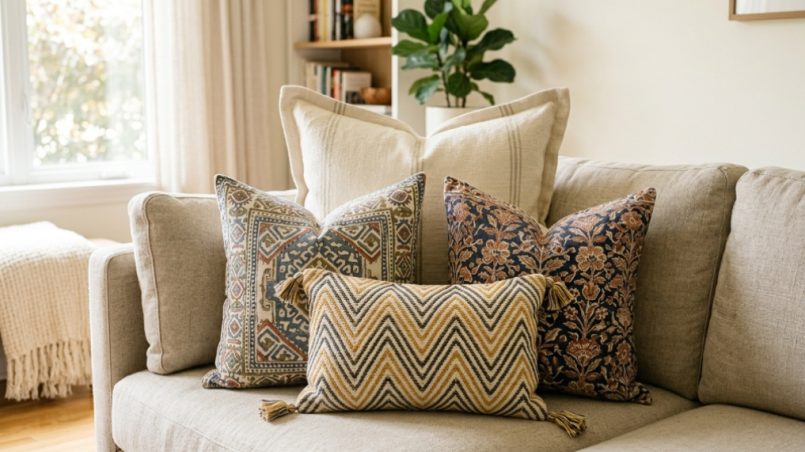
A sofa without throw pillows can feel a little unfinished, but a sofa with the wrong pillows can feel worse. Many people pile on cushion after cushion only to find the seating is now cramped, the colors clash, or the whole arrangement looks flat. Balance is not about symmetry or spending more money. It is about understanding scale, texture, and color, and how each pillow works with the others. A useful starting point is to see how a single statement piece can anchor an arrangement, like this comprehensive review of the Uvvyui decorative knot pillow, which shows how one distinct shape can change the feel of a whole seating area.
Quick Answer
Build a balanced sofa pillow arrangement by working in odd-numbered groups, varying pillow sizes, and mixing textures and colors within a consistent palette. Start with two large base pillows in each corner, add one medium pillow per side, then place a small or shaped accent pillow in the center or front. Use no more than five to seven pillows on a standard three-seat sofa so the seating stays usable.
Key Takeaways
- Odd numbers (three, five, or seven) usually look more natural than even numbers because they avoid perfect mirroring.
- Size variety matters more than pillow count: large, medium, and small pillows in one arrangement create depth.
- Stick to two or three colors and repeat them across the arrangement to avoid a cluttered look.
- Shaped or sculptural pillows like knot balls work best as a single focal accent, not in multiples.
- Always test that the arrangement leaves enough seat space for people to actually sit comfortably.
Start With Size, Not Style
The most common mistake is choosing pillows by pattern or color first. Size determines whether an arrangement looks balanced before color ever enters the picture. A sofa covered in same-sized pillows tends to look flat, even if the colors are beautiful.
A reliable size framework for a standard three-seat sofa:
- Two large pillows (20–24 inches): One in each corner. These act as the visual anchors.
- Two medium pillows (16–20 inches): Layered slightly in front of the large ones, one per side.
- One small or shaped accent (12–16 inches or a sculptural piece): Placed front and center or offset to one side.
This creates a gentle pyramid shape that draws the eye inward and keeps the center of the sofa visually open. If your sofa is a two-seater, reduce this to three pillows total. For a sectional, repeat the same pattern at each corner rather than spreading pillows evenly along the entire length.
Why Odd Numbers Work Better Than Even Ones
Odd-numbered groupings tend to feel more relaxed because they avoid the stiff, mirrored look of perfectly matched pairs. Three pillows on a loveseat or five on a full sofa gives the eye something to move across instead of two identical halves facing each other.
This is not an absolute rule. A deliberately symmetrical arrangement with four pillows can look elegant, especially in formal living rooms. But if your goal is a comfortable, lived-in look, odd numbers are the easier starting point. If symmetry is what you want, commit fully to it, matching sizes, shapes, and colors on both sides, because a half-symmetrical arrangement usually looks accidental rather than intentional.
Mixing Textures Without Creating Chaos
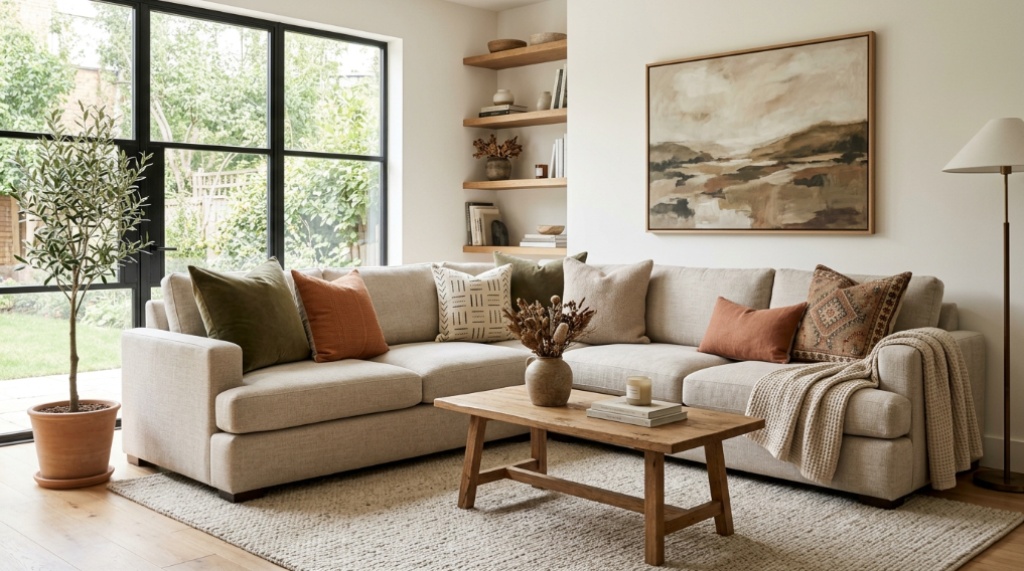
Texture is where most arrangements either come alive or fall apart. A sofa with five smooth cotton pillows in five colors looks busy but flat. A sofa with three pillows in the same color but different textures (linen, velvet, boucle, or a knitted knot) looks rich and intentional.
A practical rule: keep the color palette to two or three colors, then vary the textures within that palette. For example, a neutral palette might use cream linen, cream boucle, and a warm beige velvet. The contrast comes from how the materials catch light, not from how many colors you introduce.
This is also where shaped pillows earn their place. A knot ball pillow, for instance, adds a rounded, sculptural texture that flat square pillows cannot provide. Used as a single accent among flatter pillows, it creates contrast without overwhelming the sofa. Used in a group of three identical knot pillows, it can start to look repetitive and take up seat space that square pillows would use more efficiently, Beyond couch aesthetics, proper neck alignment plays a crucial role in daily comfort, especially if you suffer from tension headaches—learn more in our guide on how to relieve migraines with a cervical pillow.
Color Strategies That Actually Hold Up
There are three color approaches that work reliably on almost any sofa:
- Monochrome: One color family in different shades (for example, three tones of gray). Simple, calm, and hard to get wrong.
- Neutral plus one accent: Base pillows in cream, tan, or gray, with one or two pillows in a single bolder color. This is the safest way to add personality.
- Complementary pairing: Two colors opposite each other on the color wheel (like blue and orange). High impact, but requires restraint, usually limiting the brighter color to one or two pillows.
Avoid introducing more than three colors unless the room already has a strong multi-color theme, such as a patterned rug or artwork. The pillows should echo the room, not compete with it.
A Simple Step-by-Step Arrangement Method
- Clear the sofa completely so you can see its actual proportions.
- Place one large pillow in each corner, angled slightly inward.
- Add one medium pillow in front of each large pillow, offset just enough to show both.
- Place a single small or shaped accent pillow in the center or offset toward one side.
- Step back at least six feet and check the shape. If it looks lopsided, adjust angles before adding or removing anything.
- Test the seating. Sit down. If you have to move pillows to sit comfortably, remove one.
That last step matters more than it sounds. A beautiful arrangement that nobody wants to sit in defeats the purpose of a sofa.
When to Break the Rules
Once the basic framework feels natural, you can adjust it for specific situations:
- Deep sofas: Use larger base pillows (22–24 inches) so the arrangement does not disappear into the seat.
- Small loveseats: Three pillows maximum, and keep them on the smaller side to preserve usable seating.
- Formal or minimalist rooms: Fewer pillows, held back from the front edge, often look better than a full layered arrangement.
- Kids or pets in the house: Skip delicate or oversized accent pillows and favor washable covers in durable fabrics.
There is no single correct number of pillows. The goal is an arrangement that looks deliberate from across the room and still functions when someone sits down.
Frequently Asked Questions
How many pillows should go on a three-seat sofa?
Five to seven is the practical range for most three-seat sofas. Fewer than five can look sparse on a large sofa, while more than seven usually crowds the seating and makes the arrangement feel heavy.
Should sofa pillows match exactly or coordinate?
Coordinating works better than exact matching in most cases. Keep colors and textures related but not identical, so the arrangement has depth rather than looking like a single repeated item.
Can I use a knot pillow as the main accent on a sofa?
Yes, as long as it is treated as an accent rather than a base pillow. Knot and ball-shaped pillows are typically small and sculptural, so they work best as one focal piece in front of larger square or rectangular pillows.
Do odd numbers of pillows always look better?
Not always, but they are more forgiving. Even-numbered arrangements can look elegant when they are intentionally symmetrical, but they look unbalanced when the symmetry is only partial.
How do I keep pillows from sliding off a leather sofa?
Leather offers less friction than fabric. Choosing pillows with textured backs, using slightly larger sizes, and leaning them against the sofa arms or backrest rather than resting them flat on the seat all help them stay in place.
Should pillow colors match the sofa or contrast with it?
Either can work. Matching or tonal pillows create a calm, seamless look, while contrasting pillows add visual interest. A common middle ground is neutral base pillows with one or two contrasting accents.
Conclusion
A balanced sofa pillow arrangement comes down to size variation, a restrained color palette, and odd-numbered groupings that leave room to sit. Start with two large corner pillows, layer in two mediums, and finish with one small or shaped accent. Adjust from there based on your sofa’s depth and how the room is used. The arrangement should look intentional from across the room and still feel comfortable up close, and if you get that balance right, the pillows will do most of the decorating for you.