
If you wake up with a stiff, aching lower back every morning, you’re not alone. That sharp twinge when you stand up is often caused by the way your spine is aligned while you sleep. But there’s a simple, drug-free tool that can transform your recovery: a knee pillow. This small, ergonomic cushion sits between your legs to keep your hips, pelvis, and spine in a neutral position. Throughout this guide, we’ll explain exactly how to use a knee pillow for back pain relief, what to look for when buying one, and how to maximize your results for a deeper, pain-free sleep.
What Is a Knee Pillow and How Does It Relieve Back Pain?
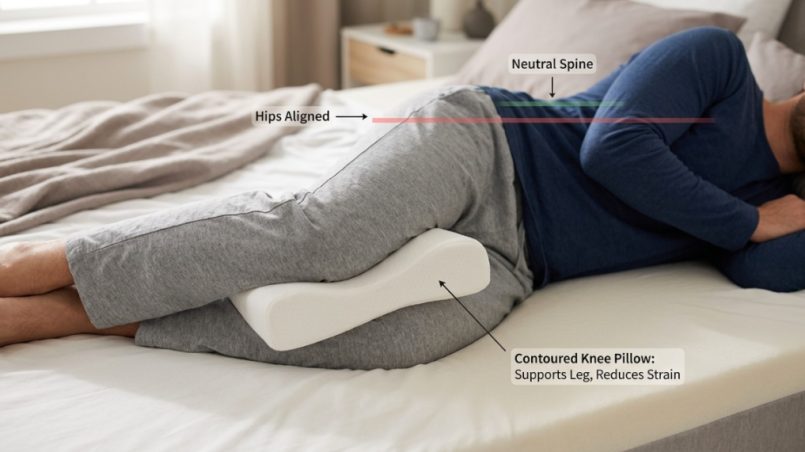
A knee pillow is a specially shaped cushion placed between your knees while sleeping on your side. It works by elevating the top leg, which prevents the pelvis from twisting and keeps the spine in a straight, neutral line. This simple addition reduces stress on the lumbar discs, joints, and surrounding muscles, offering significant knee pillow for back pain relief for millions of sleepers.
The Anatomy of Sleep Alignment
Your spine has a natural S-curve that must be supported evenly when lying down. When you side-sleep without a pillow between your knees, your top leg drops forward and pulls your pelvis into a rotated position. This creates a ‘twist’ in the lower spine, which is a leading cause of morning stiffness. A knee pillow fills that gap, keeping the femur (thigh bone) parallel to the floor.
Why Side Sleepers Need This Specific Support
Side sleeping is generally recommended for back health, but only if done correctly. Without a prop, the top hip muscles (gluteus medius) and the IT band are stretched excessively, leading to bursitis or sciatica-like pain. By maintaining a stacked hip position, the knee pillow decompresses the spine and allows the deep core muscles to relax, promoting blood flow and healing during the night.
Immediate Benefits You Can Feel the Next Morning
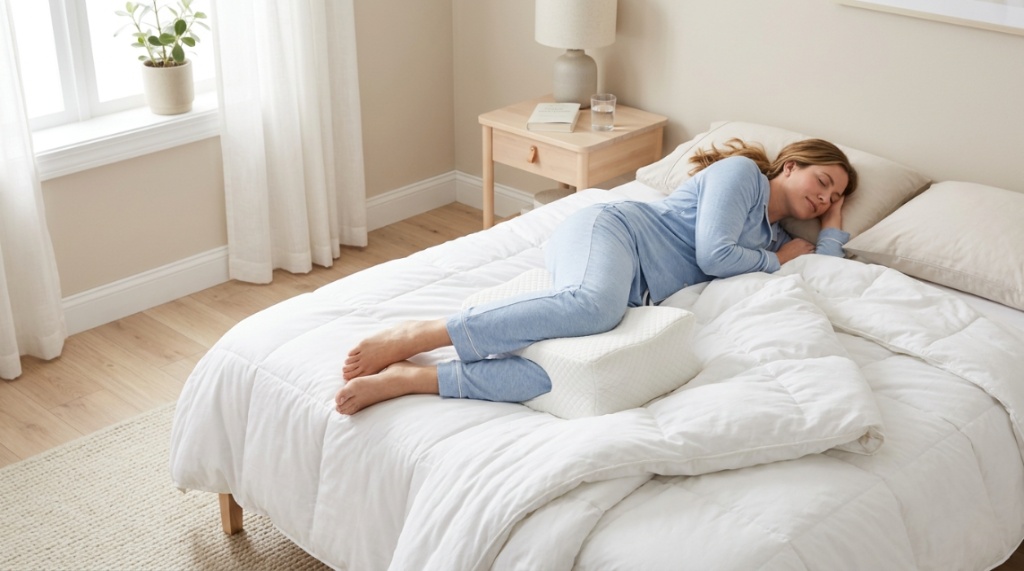
- Reduced morning stiffness in the lower back and hips.
- Less numbness or tingling in the legs and feet.
- Improved circulation in the lower extremities.
- Better sleep quality due to reduced tossing and turning.
Why Is My Current Sleep Position Causing Lower Back Pain?
Most back pain is mechanical, not structural. If you sleep on your back with a thick pillow under your head, or on your stomach, you are forcing your cervical and lumbar spine into a forced flexion. This compresses the discs, impinges nerves, and overstretches ligaments, leading to acute spasms.
The Dangers of Stomach Sleeping
Stomach sleeping is the absolute worst position for spinal health. It forces the neck to be rotated 90 degrees for hours, and the lower back arches excessively, straining the facet joints. The knee pillow technique doesn’t work here because you can’t place it between your legs. If you must break this habit, place a flat pillow under your stomach to lift the pelvis, but transitioning to side-sleeping with this cushion is highly recommended.
Why Back Sleeping Isn’t Always the Answer
While back sleeping is better than stomach, it isn’t perfect. For individuals with severe lordosis (pronounced lower back curve), sleeping flat can increase pressure on the lumbar spine. While you can use a knee pillow under your knees for back sleepers, the most effective way to manage pelvic rotation for side sleepers is to place it precisely between the knees, Creating a supportive sleep environment goes beyond just fixing your posture. Once you have relieved your back pain with a knee pillow, you can further optimize your bedroom sanctuary by choosing furniture that reduces clutter—such as nightstands with built-in charging stations to keep your sleep space tidy and wire-free.
Understanding Muscle Compensation and Spasms
When your spine is misaligned for 7–8 hours, your psoas muscle and quadratus lumborum work overtime to correct the imbalance. This leads to spasms, fatigue, and pain. A leg separator prevents this compensation cycle entirely, allowing the erector spinae muscles to lengthen and relax. This is why the relief is often immediate upon waking.
How to Choose the Perfect Knee Pillow for Your Body
Not all knee pillows are created equal—height, density, and material matter significantly. The right pillow should match the width of your hip to ensure your pelvis doesn’t tilt. A pillow that’s too high will misalign your hips; one that’s too low won’t support the top leg, rendering it useless.
Measuring the Correct Height and Loft
To determine the correct loft, stand upright and place your feet hip-width apart. Ask someone to measure the space between your knees. That measurement is the exact height your pillow needs to be. If your knees are snugly stacked with a straight spine, you have the right fit. Most standard pillows are 4 to 6 inches thick, but contoured options vary.
Comparing Foam Types: Memory Foam vs. Latex
| Material | Pros | Cons | Best For |
|---|---|---|---|
| Memory Foam | High contour, shape retention, even pressure relief | Retains heat, heavy, may off-gas | Side sleepers with hips |
| Latex | Responsive, buoyant, stays cool, durable | More expensive, firmer feel | Warm sleepers |
| Polyester Fiber | Lightweight, cheap, adjustable | Flattens quickly, poor support | Travel or side sleepers with light hip width |
Key Features to Look For (Straps, Contours, and Covers)
Look for a pillow with a contour that has a slight dip in the middle to cradle the leg. A strap or attachment band is crucial if you move a lot at night—it keeps the pillow locked to your thigh. Also, ensure the cover is removable and washable, as hygiene is essential for skin health. A breathable mesh cover prevents sweat build-up between the legs.
When Should You Use a Knee Pillow for Optimal Results?
You should use the pillow every single night, regardless of whether you feel pain at that moment. Consistency is key because spinal decompression is cumulative. However, you should also use it during short daytime naps if you lie on your side, to prevent the same misalignment from interrupting your rest.
Using It During Recovery and Physical Therapy
If you have an acute injury like a herniated disc, using the pillow during bed rest minimizes aggravation while you recover. For those in physical therapy, performing exercises like ‘clamshells’ with the knee pillow between your legs can add resistance and improve form. It also aids in post-operative hip replacement recovery by preventing crossing of the legs.
Exercises to Pair With Your Knee Pillow
Don’t just sleep with it—use it actively. Lying on your side, place the pillow between your knees and squeeze them together for 10 seconds, then release. Repeat 15 times. This strengthens the gluteus medius, which stabilizes the pelvis. Another exercise involves pressing your top knee down into the pillow while keeping your feet stacked, activating the oblique muscles.
The Role of Sleeping Posture Over Time
As you sleep, your body naturally shifts. You may start as a side sleeper and roll onto your back. If you wake up with the pillow on the floor, you were likely tossing. The best approach is to use a pillow with a strap to keep it in place so that no matter what angle you sleep at, your knees remain aligned and your spine is protected for the duration of the night.
Can a Knee Pillow Help with Sciatica and Pregnancy related Back Pain?
Yes. Sciatica (pain radiating down the leg) is often worsened by piriformis syndrome—a tight muscle in the buttock pressing on the sciatic nerve. A knee pillow prevents the top leg from rotating inward, which relaxes the piriformis. For pregnant women, the pillow is a lifesaver, reducing pressure on the inferior vena cava and improving venous return, which reduces swelling in the legs and feet.
Addressing Sciatic Nerve Compression
By keeping the top knee elevated, the pillow takes the stretch off the sciatic nerve pathway. This reduces radiating pain, numbness, and tingling. It is a non-pharmaceutical way to manage neuropathic symptoms, often proving more effective than opioids or muscle relaxers because it targets the root mechanical cause.
Specific Benefits for Expecting Mothers
Pregnancy increases the load on the lower back and widens the pelvis. Sleep becomes a challenge due to a growing belly, and backaches are common. A knee pillow positions the top leg to open up the pelvic outlet, easing symphysis pubis dysfunction (SPD) pain, and it supports the uterine ligaments, preventing tugging and spasms.
Addressing Conditions like Herniated Discs and Arthritis
If you have a herniated disc, the pillow reduces intradiscal pressure by preventing rotation. For those with hip arthritis or bursitis, the cushion prevents the bones from rubbing together in the joint. Even for those with sciatic scoliosis, the gentle stretch helps align the spine and reduce curvature progression during rest.
How to Integrate a Knee Pillow into Your Nightly Routine
To maximize relief, you must combine the pillow with good sleep hygiene. This means sleeping on a mattress that isn’t too soft, using a suitable ergonomic pillow for your head, and keeping a neutral spine throughout the night. Start by getting into bed on your back, then roll to your side, placing the pillow in place before settling down.
Step-by-Step Guide to Sleeping Correctly
- Position: Lie on your side with your shoulder directly under your neck.
- Placement: Place the knee pillow between your knees, ensuring it spans from mid-thigh to mid-calf.
- Alignment: Adjust the cushion until your top hip doesn’t sag toward the bed.
- Head Support: Use a medium-firm pillow under your head to fill the gap between your shoulder and the mattress.
- Stabilization: If you toss and turn, fasten the pillow’s strap to your top leg.
Common Mistakes to Avoid (Too High or Too Low)
A common mistake is placing the pillow only under the knee joint, leaving the thigh unsupported. This creates pressure on the calf. Ensure the pillow supports the entire length of the leg. Another mistake is using a normal bed pillow—they are too soft and flatten, whereas a contoured foam holds shape. If your pillow pushes your knees apart too wide, it’s too tall; switch to a lower loft model.
Complementary Products for Maximum Relief
Pair your knee cushion with a lumbar roll for lower back arch support and an adjustable base to elevate your head slightly, which reduces GERD and snoring. Many experts actually recommend using a total sleep system—a supportive mattress, a contoured pillow, and the leg separator—to effectively treat chronic conditions. For more guidance on selecting the best option for your budget, check out this knee pillow for back pain relief guide, which reviews top-rated options based on firmness and ergonomics.
Is There a Risk of Using a Knee Pillow?
For most people, it’s completely safe and beneficial. However, if you have a severe knee joint infection, open wounds, or recent surgery on the lower limbs, you must consult a doctor first. Also, if you sleep exclusively on your back, a knee pillow isn’t the right tool—you’ll need a bolster under the knees instead of between them to achieve the same spinal decompression.
Who Should Avoid It
Individuals with knee osteoarthritis might find pressure from the pillow uncomfortable if it’s too hard. This is why a softer memory foam or latex core is better for this group. People with severe vascular conditions like DVT (deep vein thrombosis) should also avoid concentrated pressure on the popliteal vein (behind the knee), which may restrict blood flow.
What If It Feels Awkward at First?
Our bodies are creatures of habit. The first two nights might feel weird because you are breaking the pattern of twisted sleeping. Stick with it. After three nights, your brain will associate the pressure between your legs with comfort and rest. Give it a minimum of a week to see the real advantages for your spine, as muscle memory requires time to adjust.
Consulting a Professional for Chronic Pain
If you have tried the best knee pillow for back pain relief and still feel intense pain, you likely have a structural issue that requires medical diagnosis. See a physical therapist or an orthopedist for a full assessment. X-rays can show whether your leg length discrepancy is causing the misalignment (if so, you’ll need a shoe insert, not a pillow).
Frequently Asked Questions
Can I use a knee pillow under my knees if I sleep on my back?
Yes. If you are a back sleeper, place a cushion under both knees to relieve tension on the lower back. It creates a slight bend in the knees, flushing out the psoas muscle and taking pressure off the lumbar discs. It is not the same as between-knee placement, but both are effective.
How often should I replace my knee pillow?
Most foam knee pillows built with quality materials last 18–24 months, depending on how often you use them and their density. If you notice it flattens easily or cracks, it’s safe to replace it right away. You want to avoid a flattened pillow that allows your legs to touch, defeating the purpose.
Are cooling gel knee pillows better for back pain?
Cooling gel added to memory foam improves airflow and dissipates heat, making sleep more comfortable, but it does not add to the pain-relieving benefits. The cooling effect helps you stay longer in alignment, indirectly aiding recovery. It doesn’t change the structural support.
Can a knee pillow worsen hip pain?
Only if the pillow height is incorrect. If the pillow is too high, it will push your pelvis out of neutral, stretching the top hip joint. Check the alignment by having someone look at your back from behind while lying on your side; if the spine is straight, the pillow is correct.
Will a knee pillow fix my sciatica completely?
No, but it alleviates the mechanical pressure that triggers sciatic flare-ups. It often provides significant relief when combined with stretching and chiropractic care. For true cases of sciatica, target the underlying tight piriformis muscle as well—the pillow simply prevents the irritation from recurring during sleep.